
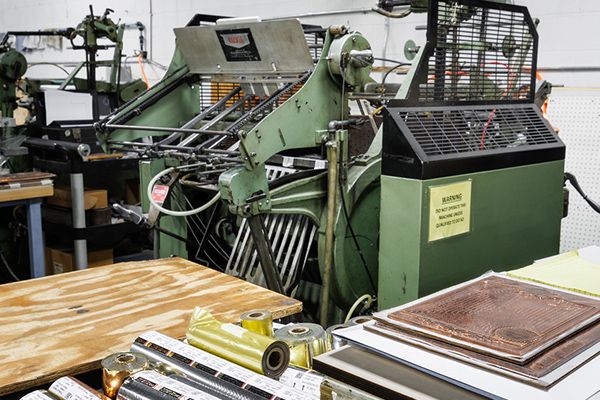
Foil stamping is one of those print finishing touches that genuinely stops people in their tracks. That reflective shimmer on a business card, the gleaming title on a book cover, the metallic accent on a wedding invitation — it signals quality in a way that ink alone simply cannot. But if you’ve started exploring foil stamping for an upcoming project, you’ve probably run into a choice: hot foil stamping or cold foil stamping. They produce similar visual results, but the processes are quite different, and the right method depends on what you’re printing, how many pieces you need, and the effect you’re after.
How Hot Foil Stamping Works
Hot foil stamping is the traditional method, and it’s been the industry standard for decades. A metal die is engraved with your design, heated, and then pressed against the foil and substrate together. The heat and pressure bond the foil to the surface, leaving behind a crisp, deeply dimensional impression. Because the die physically presses into the material, hot stamping also creates a subtle embossed effect that you can feel with your fingertips.
At Classic Laminations, we’ve been running hot foil stamping since 1976, and we’ve refined the process across thousands of projects. Our press handles sheet sizes up to 23″ x 28″, which gives us room to work on everything from single business cards to large press sheets with multiple images stepped out. Clients in Cleveland, Strongsville, and across Cuyahoga County rely on this method for packaging, specialty covers, certificates, promotional pieces, and anywhere a bold, premium feel is the goal.
Hot stamping works beautifully on uncoated and coated stocks, leatherette, cloth, and a range of specialty substrates. The limitation is setup time. Because a custom die is required, hot foil stamping is better suited to longer runs where that upfront cost is spread across more pieces.
How Cold Foil Stamping Works
Cold foil stamping skips the heat entirely. Instead, a UV-curable adhesive is applied to the substrate in the shape of your design, the foil is then pressed onto the adhesive and cured with ultraviolet light, and the excess foil is stripped away. Because there’s no engraved die involved, the design comes straight from a printing plate, which makes cold foil a more flexible option for complex, fine-detail work or photographic-quality foil coverage.
Cold foil also plays well with inline digital and offset printing workflows, which is why it’s become popular among commercial printers looking to add foil accents without a separate finishing step. If you’re running shorter quantities or need a foil effect across large coverage areas with fine gradients, cold foil is worth a close look. We work with printers and designers throughout Akron, Columbus, and Dayton who bring us projects that call for exactly this kind of flexibility.
Comparing the Two: Key Differences
The choice between hot and cold often comes down to a few practical factors.
- Tactile quality. Hot foil stamping produces a more pronounced dimensional impression. If the raised or debossed feel of the finished piece matters, hot stamping wins. Cold foil sits flatter on the surface.
- Detail and coverage. Cold foil handles intricate detail and large coverage areas with more consistency. Hot stamping excels at bold, defined shapes but can struggle with very fine hairlines or extremely large solid fills.
- Run length. For high-volume runs, hot foil stamping is often more cost-effective once the die cost is absorbed. For shorter runs or variable designs, cold foil has the edge.
- Substrate compatibility. Hot stamping tolerates a wider variety of substrates, including textured stocks and non-paper materials. Cold foil generally works best on smooth, coated sheet-fed offset stocks.
- Turnaround. Cold foil can move faster since there’s no die fabrication involved. Hot stamping requires die production time, though the resulting piece often has a heirloom quality that justifies the wait.
Which One Should You Choose?
There’s no single right answer, and honestly, the best way to decide is to talk through your project with someone who knows both processes well. If you’re a printer or designer in the Cleveland metro area, Strongsville, Akron, Columbus, Dayton, or anywhere across Ohio and Indiana, we’re happy to walk you through the options based on your substrate, quantity, design complexity, and budget.
Classic Laminations has been helping the graphic arts and printing community make exactly these kinds of decisions for 50 years. James Tidd and our team have seen nearly every variation of foil project imaginable, and we’ll give you a straight answer rather than a sales pitch.
If you have a project in mind and want to figure out which foil method makes the most sense, please give us a call or drop us an email. We’re always glad to help you get the finish right.